

To reduce med spa consultation no-shows, improve the booking decision before adding more reminders. People attend when the appointment is relevant, expectations are clear, timing is convenient and changing the booking is easy.
Automation should remove friction, not create a stream of repetitive messages.
Measure the real baseline
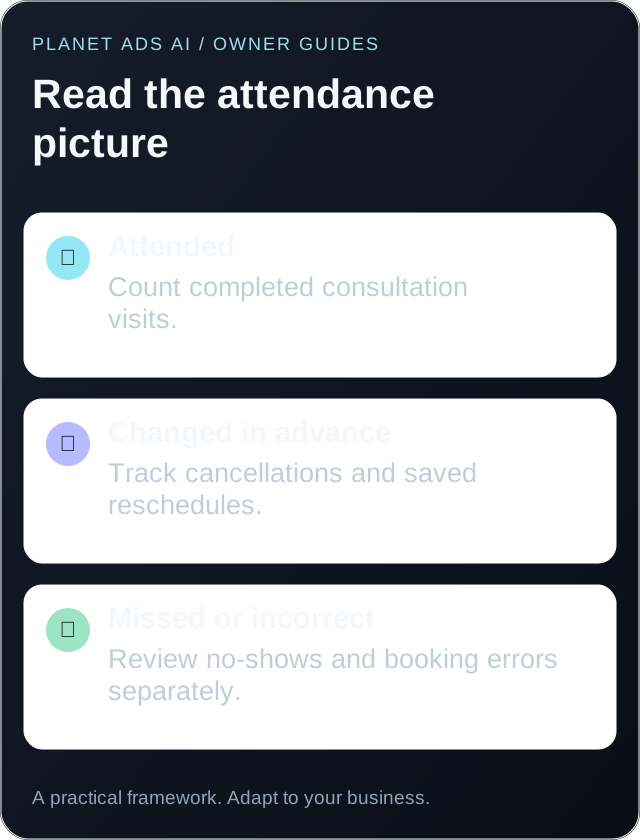
Separate outcomes:
- attended;
- rescheduled in advance;
- cancelled in advance;
- same-day cancellation;
- no-show;
- duplicate or invalid booking;
- staff-created scheduling error.
Segment by treatment, source, provider, location, day, time and booking lead time. A high overall no-show rate may be concentrated in one campaign or appointment type.
Confirm the appointment clearly
The confirmation should include:
- med spa name;
- consultation type;
- provider, if relevant;
- date, local time and location;
- duration or arrival expectation;
- approved preparation information;
- deposit and cancellation terms;
- one-tap reschedule or contact path.
Do not bury the location or require the person to call during business hours just to change a time.
Use a respectful reminder sequence
The exact timing depends on the service, lead time, consent and local rules. A practical pattern is:
- immediate booking confirmation;
- an earlier reminder that makes rescheduling easy;
- a short final reminder close enough to be useful;
- optional same-day directions or arrival information.
Every message should identify the business and provide a clear way to change or cancel. Stop marketing content when the communication is intended as an appointment reminder.
Ask for confirmation without creating work
Use a reply the system can process:
“Your consultation with [Med Spa] is scheduled for [date/time] at [location]. Reply C to confirm or R to reschedule.”
If the person replies with a question, preserve the appointment while routing the question. Do not cancel automatically because the reply was not exactly formatted.
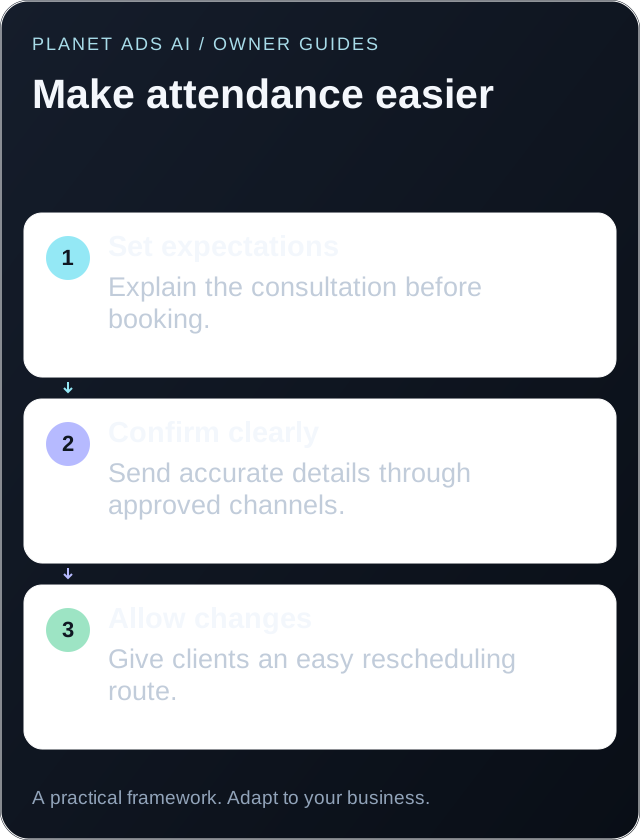
Set expectations during the first conversation
The receptionist should explain:
- what the consultation is for;
- who the person will meet;
- whether treatment happens that day;
- what to bring;
- how deposits or late cancellation work;
- how to ask clinical questions before arriving.
Avoid promising eligibility, results or exact treatment pricing before assessment unless the med spa has explicitly approved that information.
Create a reschedule rescue path
When a person cannot attend, offer real alternatives instead of treating the change as a lost lead:
“No problem. Would later this week or next week be easier?”
If no slot fits, add a named callback or waitlist action. Confirm the old appointment was released only after the new plan is clear.
Use deposits carefully
A deposit may improve commitment, but it can also reduce bookings or create disputes when terms are unclear. If the med spa uses deposits:
- disclose the amount before payment;
- state refund and transfer rules plainly;
- confirm the receipt and appointment;
- give staff authority to handle exceptions;
- measure attended consultations, not deposit collection alone.
Review no-shows weekly
For each no-show, inspect:
- source and promise in the advertisement;
- time between booking and appointment;
- confirmation delivery;
- reminder delivery and replies;
- unanswered questions;
- reschedule attempts;
- appointment accuracy;
- previous client history where appropriate.
Fix patterns. If one campaign attracts curiosity but few attendees, the answer may be stronger qualification or clearer creative, not more reminders.
KPIs to track
| KPI | Why it matters |
|---|---|
| Confirmation rate | Shows whether contact details and messaging work |
| Reschedule rate | Separates saved appointments from lost ones |
| Attendance rate | Primary operational outcome |
| No-show rate by source | Reveals campaign-quality differences |
| Booking lead time | Shows whether long waits affect attendance |
| Manual recovery time | Captures operational cost |
Calling and texting rules vary by jurisdiction. Use channels the person agreed to, honor opt-outs and get professional guidance for your locations.
Calculate attendance without hiding the losses
Use a consistent appointment cohort, such as consultations scheduled to take place in a particular week. Record the final outcome for each appointment. Count reschedules separately and connect the replacement booking so one person is not mistaken for two new prospects.
For an illustrative week with 40 scheduled consultations, suppose 28 attend, six cancel in advance, four do not attend and two are moved by the clinic. Reporting only the 28 attendees and four no-shows would hide a meaningful part of the operational picture. Keep the full breakdown visible and state the denominator whenever you report a rate.
Review attendance by source only when the sample is useful. A few bookings from a new campaign can swing a percentage sharply. Look at the actual conversations before declaring that an entire channel attracts unreliable clients.
What should you say after a missed consultation?
Use a considerate message that makes it easy to continue without assuming why the person missed the visit:
“Hi [Name], this is [Med Spa]. We missed you at your consultation today. If you would like to rearrange it, reply here or contact the team at [number].”
Send it only through an approved channel and contact process. Apply any cancellation or deposit policy consistently, but do not turn the message into a reprimand. If the person explains a clinical concern or complaint, route it to the correct team rather than continuing a booking sequence.
Test one improvement at a time
Choose the most visible cause first. If clients often arrive at the wrong location, improve the confirmation and directions. If they thought treatment was included, clarify the consultation before booking. If they cannot change an appointment easily, improve rescheduling before adding reminders.
Keep the test period and reporting definitions consistent. Review both attendance and the staff time required to manage the change. A complex reminder workflow that produces constant manual correction may be less useful than a clearer confirmation and a reliable human response.
The med spa follow-up guide explains how to stop prospect messages after booking so reminders do not compete with an outdated sales sequence.
Connect this workflow with med spa lead follow-up automation and the med spa AI Receptionist call script.