

The right dental marketing agency should explain how its work will help your practice attract suitable enquiries and turn them into attended appointments. Before comparing proposals, decide which patients you want more of, how much capacity you have and what your front desk can reliably handle.
A polished proposal can make every agency look similar. The differences become clearer when you ask about responsibilities, patient outcomes and what happens when a campaign does not work as expected.
Start with the practice problem you need to solve
“More patients” is a reasonable goal, but it is not a complete brief. A new general practice filling its schedule has a different need from an established clinic seeking more full-arch consultations. A clinic already receiving plenty of enquiries may need better call handling before more advertising.
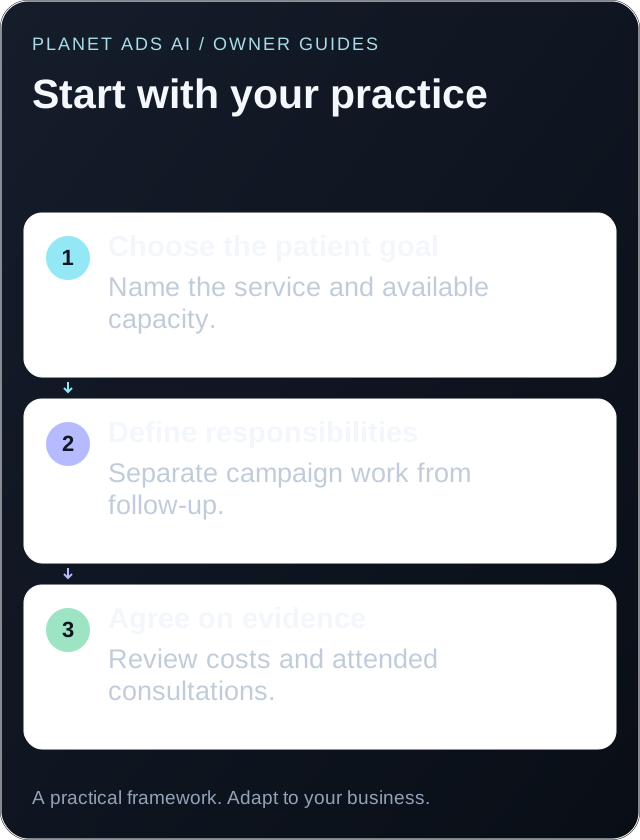
Write down four things before meeting an agency:
- The service or appointment type you want to grow.
- The location and practical travel area you serve.
- The number of additional appointments your team can accommodate.
- The part of the journey currently failing, if known.
Share what you know and label what you do not. If you have not tracked attendance by source, say so. A useful partner should help establish the baseline rather than build a forecast on invented figures.
For an implant-focused brief, use the dental implant Meta ads guide to understand the full journey from advertising to consultation.
Choose the right type of help
Not every dental marketing company provides the same service. Some concentrate on websites and local search. Others manage paid campaigns, content, reception or a combination. Ask what they actually deliver and who owns the work.
| Your main problem | What to investigate |
|---|---|
| Few local people find the practice | Local visibility, website clarity and relevant acquisition channels |
| Plenty of website visits but few enquiries | Offer, page experience, trust and contact friction |
| Paid leads arrive but do not book | Lead quality, response process, appointment availability and message consistency |
| Calls often reach voicemail | Reception coverage and callback ownership |
| Consultations book but do not attend | Expectations, confirmations, scheduling and follow-up |
Do not purchase a broad package just because it lists many services. Ask which change the agency would prioritize and what evidence would show that it helped.
Ask how success will be measured
A useful report connects spending with business outcomes. It should distinguish an enquiry from a booking, and a booking from an attended consultation. Where the practice can reliably track further outcomes, treatment acceptance and collected revenue provide additional context.
The American Dental Association’s guidance on measuring marketing success discusses measures such as new patients, cost per contact and the cost of acquiring a patient. Those are more useful starting points than a report built only around clicks.
Ask for a sample report before signing. Can you tell what changed, what the agency learned and what it will do next? Are duplicate enquiries excluded? Is the source clear? How are delayed treatment decisions handled?
A small number of early leads can produce unstable percentages. The agency should explain that uncertainty, not hide it behind a precise-looking forecast. Ask to see the actual counts alongside rates.
Check dental experience without accepting vague claims
Ask about work with practices whose service, market or buying process resembles yours. A campaign for routine hygiene appointments is not identical to an implant consultation campaign. Experience is helpful when the provider can explain the difference in patient questions, creative needs and follow-up.
Request permission-based testimonials or examples the agency is allowed to share. Look for the scope of work, timeframe and context. An impressive revenue number without ad spend, costs or attribution is difficult to evaluate.
Do not expect an agency to share another practice’s private patient data. It should be able to discuss its approach without exposing sensitive information. The same care should apply when it handles your own account.
Planet Ads’ Dr. Tomas video testimonial provides one client’s perspective on the marketing relationship. A testimonial describes that experience; it is not a promise of the same results for another practice.
Understand the full investment
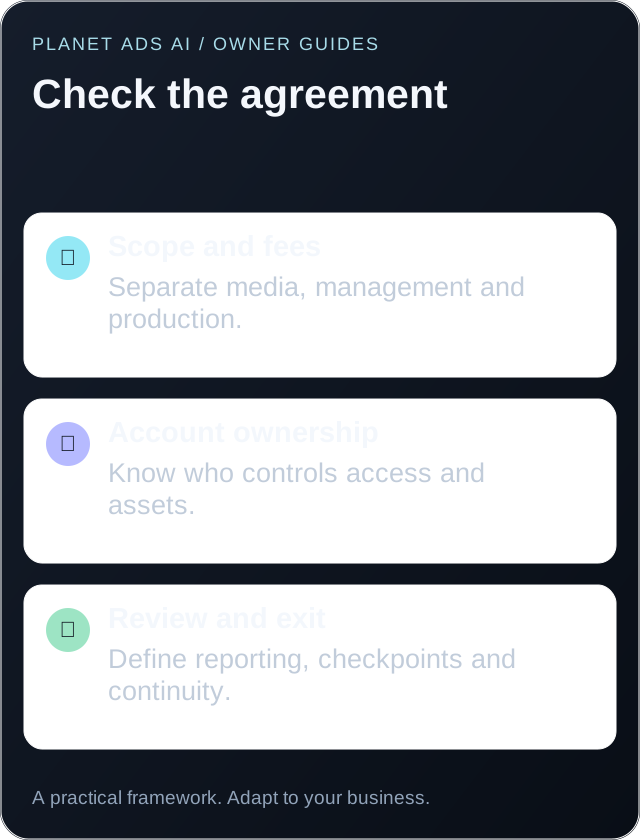
Separate management, media spend, setup and original production. Ask which fees repeat, which are one-time and which change when spending increases. Make sure the proposal states whether landing-page work, tracking implementation and creative production are included or separately scoped.
For Planet Ads Advertising, management is $1,500 per month or 15% of monthly ad spend, whichever is higher. The one-time Ads setup fee is $1,500. Meta advertising spend is paid directly to Meta, separately from the Planet Ads fee.
Normal ad variations using existing or supplied assets are included in management. Major original production, such as filming, custom video ads or large creative batches, is quoted separately.
As an illustration, $5,000 per month in Meta spend means $1,500 in monthly management, for $6,500 per month after setup. Over a 2-month pilot, including the $1,500 setup fee, the planned total is $14,500: $4,500 paid to Planet Ads and $10,000 paid to Meta. This excludes separately agreed production and any applicable taxes or additional scope.
See pricing for a simple overview or use the investment calculator to explore the published assumptions. Larger or more complex requirements need a written scope.
Confirm who owns accounts and access
Before signing, clarify ownership and administrator access for advertising accounts, domains, landing pages, analytics and creative assets. Ask how you receive exports and what remains accessible if the relationship ends.
The goal is continuity. Your practice should understand where campaigns run, where enquiries arrive and who can make changes. Shared passwords and access controlled by one unavailable person create unnecessary risk.
Also ask who pays the media platform and how spending is approved. A management invoice and an advertising charge are different expenses. Your reporting should make that distinction easy to follow.
Make follow-up part of the agreement
An agency can generate an enquiry without controlling how quickly the practice answers. Define the handoff together. Who receives new enquiries? Who calls back? What happens outside opening hours? How will the agency learn which enquiries become appointments?
If the practice needs reception support, scope it explicitly. AI Reception is a separate service with its own setup, usage and operating boundaries. It should not be assumed to be included in an advertising fee.
Give the front desk a short briefing whenever an offer changes. They should know what the patient saw, what the consultation includes and which questions need the treatment coordinator. An inconsistent first call can undermine otherwise clear advertising.
Set useful checkpoints for a 2-month pilot
Use a pilot to evaluate a working relationship and a defined campaign scope. Agree on the preparation needed before launch, the review schedule and the evidence required to continue.
During setup, check account access, tracking, approved creative, the landing experience and enquiry routing. After launch, review the quality of conversations and booking outcomes as well as delivery and spend. At the final review, separate confirmed findings from questions that need more time.
High-value treatment decisions may extend beyond the pilot. Continue tracking that group of enquiries so late bookings are not lost from the evaluation. At the same time, do not excuse unresolved setup or follow-up failures simply because treatment takes time.
Warning signs worth taking seriously
Pause when an agency promises guaranteed treatment revenue without understanding your practice, cannot explain its fees, refuses to define account ownership or relies on unverifiable results. Be equally cautious when the proposal assumes unlimited appointment capacity or treats all leads as equivalent.
A useful agency can explain what it controls, what your team must contribute and what it will change if evidence points in a different direction. The ADA’s guidance on marketing consultants is another reference for evaluating the relationship.
Your next step
Prepare the four-point practice brief, request a clear scope and compare providers using the same questions. If your first priority is local patient growth, read how to get more local dental patients. If you want help with Advertising, AI Reception or both, discuss your practice with Planet Ads and request a scoped 2-month pilot.